
Handwriting Help: Four Suggestions for Happy Letters
0 CommentsBy Lostcheerio on Wednesday, November 07, 2007 at 5:11 PM.
Here are four ideas for helping your child navigate this shark-infested water, especially if you're already having trouble, tears, and terror.
1. It's okay to let the child write using the typewriter or computer. This lets the kid form words, express thoughts, etc. without the pain (psychological or otherwise!) of holding a pencil. Just forming the words and having them look perfect, perfect, perfect can be very satisfying! My son’s favorite computer “game” was wordpad for a long time.
2. Get rid of whatever medium is driving the child and you crazy. If pencil and paper isn’t working, ditch it. For as long as is necessary. Write with your finger in marshmallow fluff, in fingerpaint, in sand, in chalk dust. Write on a white board with scented markers. Write with mommy’s ancient lipstick on the dishwasher. Okay, maybe not that last one. Hehehe. We used a whiteboard for everything and Benny loved it – it’s a lot less frustrating to erase when you can just swipe it off, and you don’t have to scrub at a piece of paper with an eraser. Write on sidewalks, on the side of the house with a water hose, with bubbles in the tub, etc.
3. Confound the idea of “perfection” by asking her to write silly things. Write it all in curly cues. Write it in ocean waves. Write it like a mouse would write it. Write it tiny, write it huge, write it upside down. For a small child who wants to write perfect letters but physically has a hard time doing it, one of those manuscript sheets with three lines, one dotted in the middle, one red on top, can be the height of intimidation, frustration, and potential defeat. How would a mouse write it? How would an elephant write it? You be silly, start laughing, get crazy, then sigh, shake your head and say, "Okay, well, I guess we better write it like humans now..."
4. Everyone's handwriting is different. Let your child know that we all have our own ways of writing, and try looking at different people’s handwriting. Look at all the signers of the constitution. Look for handwriting samples online. Talk about signatures and how everyone's signature is *supposed* to look different and special.
Here's a sample of Benny's writing when he was 3 1/2:

Not exactly regular, uniform, perfect or textbook! While Benny wasn’t worried about perfection, I was, initially. I tried to make him hold the pencil a certain way, stay within this and that line, and think beautiful thoughts. I convinced myself, at last, that it didn’t really matter, as long as he was happily writing letters, and having fun.. If I, a brutal perfectionist, can come to that conclusion, maybe your child can too!
Labels: handwriting, homeschooling, lessons, practice, tips
School is Awful. Just ask Junie B. Jones.
3 CommentsBy Lostcheerio on Saturday, November 03, 2007 at 9:43 AM.
I'm not homeschooling because I hate school. I'm homeschooling because I think homeschooling is cool. I'm homeschooling because I think my specific child needs it. I am completely open to the possiblity that he might want to go to school someday, and I will definitely let him try it and see how it goes.
My son is not open to that possibility. He does not like school at all -- not the idea of it, not the reality of it, not the smell, sight, or sound of it. Nothing about it interests him. Why? Where did he get this idea? I have been very, very careful in my characterization of school when we talk about it. I do not say it is a nightmare sweatshop where children go to be chained to desks for hours at a time, pushing heavy pencils across black and white worksheets until their little eyes bleed. Of course, I also do not say it is a happy valley of magic playtime where elves feed you gumdrops as you learn to play checkers better. I try to be realistic. There are good and bad things about school, like there are good and bad things about everything. (Except stale candy corn. There's nothing bad about stale candy corn. But I digress.) Benny's opinion of school is so violently negative -- when we visited Boston and stood on the site of the first public school in the country, he made this face:

Why so glum, chum? What beef could you possibly have with public schools, having attended one approximately zero times in your life? We recently attended a violin workshop at a cute local school, and Benny spent a lot of time making me reassure him that he wasn't going to have to "go to school" -- that our attendance there was only temporary and completely disconnected with enrollment. Sadie liked it. Driving away on the last day, she said she wanted to go back there again. Benny immediately jumped in and said, "No Sadie! You don't want to go to school! Don't listen to her, mother. She just likes the playground. Sadie, you can get a playground anywhere! You don't have to go to school to get a playground!"
Where does this prejudice come from? Is there a back room of my mind, where a "school is bad" filmstrip is playing? Has he been able to perceive this opinion without my intention?
Then I look at the books I have exposed him to, and the shows he has watched on TV. What images of school has he seen, what situations have been dramatized for him? Guess what? More often than not, school is portrayed in books and on TV as a stressful place where bullies torture you, teachers misunderstand you, and lessons confound you. A place where you feel trapped, bored, and rebellious. There's Junie B. Jones, manipulating and suffering her way through first grade, and there are the Captain Underpants boys. Even a pious, innocuous little PBS show like Arthur shows school as a dangerous territory to be navigated with fear and trembling. I suppose the episodes are written in an exaggerated way so that school children can relate to them, and can learn to deal with reality. But how does that classroom look, to a kid who's not in school? Every day there's a new problem. Maybe Benny is getting his impression of school from these books and TV shows. I can see how that might happen.
So is contemporary children's entertainment just a secret propaganda tool for the homeschooling army? Do any of these fictional children enjoy school, do any of them have fun and interesting teachers, good friends, and happy days? There are a few books and shows that do not portray school as a hellscape of oppression and gloom. Dora the Explorer is one, but of course it is, because Dora is an unschooler. (Or possibly just a neglected child whose parents should probably be reported to CPS -- but let's put the best construction on everything and assume they're following her around in a magic helicopter in case the crocodiles don't abre at the right time.) Clifford the Big Red Dog portrays school as a fun place with positive interactions and favorite teachers. Magic Schoolbus has created the ultimate fun science teacher, although the kids still complain and whine in their little dialogue bubbles.

All this is symptomatic of the larger problem that exists in attitudes toward school, not just in my little child, but in the world in general. People seem to cheerfully just assume that kids hate school. That they can't wait for vacation. That they have to be forced to go. It's so much a part of the way we view childhood that we think nothing of basing a whole series of books on how rotten school is and how much kids hate it. Remember, I liked school. I was raised by teachers who made school so fun for their students that their kids didn't want summer vacation to come, they didn't want to stay home sick, they looked forward to the fun and interesting things happening every day at school. So -- is there something missing here? Why can I not understand why we don't expect that sentiment to be the norm, rather than the exception?
Maybe if most kids hate school so much, there's something wrong with the most schools, and not something wrong with most kids.
Labels: education, homeschooling, public school, schools
Charlestown and Cambridge: The Other Side of the Charles River
1 CommentsBy Lostcheerio on Thursday, October 18, 2007 at 8:36 AM.
Here is the USS Constitution, commonly known as "Old Ironsides":
We went on the tour, so we could go below decks and see the guns and hammocks and things. Benny was an active participant, AS ALWAYS. He was called on to demonstrate how the Navy in those days enlisted 8-year-olds. During our time on the ship a lot of people asked Benny if he was going to join the Navy. His political answer: "I haven't decided yet."
We climbed the Bunker Hill Monument, which has 294 steps, and that is a lot of steps:
Benny asked that we do it again and again. Hmm. No. Very claustrophobic up there at the top.
We had dinner in Cambridge, on Massachusetts Avenue between Harvard and MIT. We decided that eating at typical Harvard hangout would involve a lot of tourists or snootiness, and eating at a typical MIT hangout would involve a vending machine. So we went for in between. Here we are walking around looking at choices:
We settled on a place called, unambiguously, "Middle East."
The falafel was good. Best I've had since Chicago. The hummous (hoomis?) was not all that great, but it was really all about the falafel anyway. Benny ate an entire 1/2 pound cheeseburger with lettuce, tomato, onion, and fancy mustard. Sadie ate fries. Both refused the rice pudding and baclava -- fine, more for us.
We took a picture of Benny at MIT, but not one of Sadie at Harvard. She is being so weird about getting her picture taken. Half the time she's posing and preening, half the time she's hiding in Dan's elbow. Mysterious. Here's Benny's brain posing with MIT:
Driving around MIT and Harvard I realized a few things. Dan is an MIT type, and I am not. MIT is tall, metal and glass, no trees, no bricks, no grass (I know, I know, there are trees and grass, but that's the impression I got). Dan really liked it. It made me feel uncomfortable.
Harvard was more my speed -- grass, trees, olde bricke buildingse, and grass. Something I didn't realize: the entire main part of the campus is fenced and gated. I kind of liked that. On the other hand, I wasn't crazy about the people roaming around Harvard. They struck me as too rich and too precious. We went into a coffee joint and there were like forty-three tins of green tea, and people pompously sniffing and comparing and arguing about the relative merits. I did convince an overly monied young lady to purchase a tea called "Pinhead Gunpowder" based on absolutely nothing except the fact that I raved about it disingenuously. Heh.
This is all based on very limited time spent walking around randomly, of course, but I think I like the buildings of Harvard and the people of MIT. Dan had the opposite feeling. So, we are a good match. If our lives had been different, we might have met at that falafel place halfway between on Massachusetts Ave.
I will say, here, that I was offered early acceptance at MIT when I was a junior in high school. I could have skipped senior year and gone straight to college. I was fifteen. This week I found that I love Cambridge -- better than Boston, I think. I love the universities all over the place, I love the feeling of this endless, huge, small college town, all the brains leaking out of the windows -- it is very much a great environment for a nerd like me. But I'm very glad I didn't go to school there. I have always thought, "I could have gone to MIT -- and then what?" I'm now happy to say I have no regrets. I can't put my finger on exactly what, but something about the place made me glad for the choices I made.
My job as a homeschooling mom is to keep the children's options open. I want them to be able to choose where they want to go to school, with all varieties available. Of course, I want them to go to Old Dominion, down the street, so I can still do their laundry. But if they want to go to Berkeley or Rutgers or Oxford or... wherever, I want them to be able to pick what will make them the most happy. And I'm happy to spend a whole lot of time visiting colleges, because I just love making undergraduates buy weird tea!
Labels: boston, cambridge, college, harvard, homeschooling, mit
The Boston Freedom Trail is a Harsh Mistress
1 CommentsBy Lostcheerio on Wednesday, October 17, 2007 at 8:56 AM.
The Boston Freedom Trail is a red trail of bricks that marches you through several miles of downtown Boston, and drags you past all the most important historical sites along the way. Along the way, you see Paul Revere's grave, his house, and the church where he (or someone else, actually) hung those signal lanterns.
Grave:
House:
You see statues of Paul Revere. You look at the X-rays from Paul Revere's last hairline fracture. You observe the tree where Paul Revere once sat and ate a sandwich. Then you gaze upon the balcony where George Washington delivered his famous "As I survey the spot where Paul Revere ate a sandwich" speech.
The Freedom Trail begins at Boston Common, the big city park. The first important historical site is the state house with its glowing dome:
Here's the South Meeting House where the Bostonians had their rabble-rabble-rabble meeting before they marched down to the harbor and hurled the tea into the water. Interesting things about this: The Boston Massacre took place right outside this building, and five people died. During the Siege of Boston, when the British were trapped inside the city, they ripped the pews out of the church, dragged in a bunch of dirt, and turned it into a riding ring. Inside, you can see the spot where George Washington stood and said he was amazed that people who revere their own churches so much could so casually defile ours. Good point.
Benjamin Franklin was born on Milk Street. His birthplace is now a Sir Speedy print shop:
See the bust of Franklin, above the second floor?
Here we are in Quincy Market, having lunch and trying to get the sparrows and pigeons to eat out of Benny's hand:
And here's Sadie! She has been hiding in the stroller this whole time, refusing to let me photograph her. Let me say that every building in Boston has stairs, no one can find the ramps and elevators, and I need a flying stroller. At least the baby is happy.
Gelato in Little Italy:
We deviated from the Freedom Trail and its bossy red bricks so we could make a circuit back to the car, via Beacon Hill. Here's Benny on Charles St. I read a smug little explanation online about Charles Street, that boasted there are no neon signs and no franchises. I guess the original Dunkin' Donuts, Ritz Camera, and 7-Eleven must be on Charles Street then. And the Freedom Trail doesn't even go down it!
Benny found a shoe repair guy doing work on a boot in his little basement workshop -- it was really cool. We looked for simple machines. Benny rapped on the window and I said, "Don't knock on the glass!" You know, because it scares the shoe repair guys! Turns out shoe repair guys aren't puffer fish -- he smiled and waved at Benny.
Here's Benny at the Massachusetts Department of Mental Health. I have no caption for this:
They were filming a movie on the lagoon side of Boston Common. I peered and peered and peered to try and figure out who the stars were... WELL! We researched it when we got back to the condo. The blonde I saw was Kate Hudson and the Ben Afflecky looking person I saw was Dane Cook! And the movie was Bachelor #2. Neat! I saw a chicklit movie getting filmed! I'm totally almost famous now!
Sadie tried to sneak onto the movie set, disguised as a stroller, but they busted her. DARN. So close.
So, that was our four mile hike around the city of Boston. Two many burial grounds for Benny, and too many stairs for me. I failed to take a picture of Benny making an angry, outraged face at the plaque in the sidewalk on the site of America's first public school. His favorite thing was the huge dry fountain outside the old North Church, which he said was a racetrack, and in which he took many laps. Sadie's favorite was the duck that chased her in Boston Common. My favorite was the South Meeting House -- RABBLE RABBLE RABBLE!!!!!
Labels: boston, field trips, freedom trail, history, homeschooling
Colonial Williamsburg in Inappropriate Shoes
4 CommentsBy Lostcheerio on Wednesday, September 26, 2007 at 7:40 PM.
And we found one:
While we were there, since apparently there is more to history than fashion (or whatever), we decided to learn some things. I hadn't prepared the children for the experience, we had not read about the American Revolution or made baskets or turned geese on a spit or anything, and the truth is that I have only a loose grasp on history myself. I'm expecting myself to learn a lot as I help Benny learn about it. That is my expectation. At this point, though, I am no natural expert, unless I've recently spent some time in a book on the subject. So I put Benny in charge of directions:
When you put a seven year old boy with endless energy in charge of a map, he will want to visit locations with maximum distance from each other. That is to say, if you're at one end of Williamsburg, you'll need to next go to the other end, and then back to the first end, and back to the other end. Also, if you put a seven year old boy in charge of directions, you will spend a lot of time looking at various colonial animals.
We lucked out at the brickyard, and arrived just as another group was leaving. So Benny got a private lesson in making bricks, which was awesome. They build a kiln each year by stacking up last year's bricks into an oven, with this year's raw bricks inside, then plastering mud all over it, and lighting fires underneath for a week. Benny was able to answer a lot of questions about, for example, why these three bricks, all baked at the same time for the same duration in the kiln, came out three different colors? Answer: Distance from the actual fire. I thought that was pretty astute. He and the brickman were eye to eye on many issues, and Benny learned the material so well that he went ahead and pompously explained it to the next kid to arrive, raising a little ire. Here he is getting his lesson:
Sadie on one of the walkways at the Governor's Palace:
Benny getting to be a juror at the courtroom in the capitol building:
This was cool -- we have been studying about wind power and we got to see a post style windmill, with a wheel sticking out from it so that the miller could turn the whole thing into the wind if the wind changed direction. This was one of those cool moments where Benny spent a few minutes kindly instructing me on the way windmills are operated. It also dovetailed nicely with our gears discussions, related to the Lego League topic of the week.
Here are the children doing some colonial laundry:
Sadie's pigtails, getting some instruction:
I'm very glad we went. I hadn't been to Colonial Williamsburg since I was about Sadie's age myself. We will definitely be back for the next homeschool week, and the next. At that price, anyone in driving distance would be foolish to stay home. Benny had a blast, and Sadie enjoyed herself too, from the cellar of the Shields Tavern to the jail cell where they held Blackbeard's pirate crew before hanging them (yes, we locked Benny in, yes, he was thrilled and talked about it all the way home). I will also say that the place was crawling with some of the most mannerly, thoughtful, lovely little children. I don't think it was just a homeschool thing -- I made the conclusion that children whose parents would drag them through Williamsburg are just a cut above.
Of course, in this case, it was me getting dragged. :) Next time I'm wearing my colonial tennis shoes.
Edit: Visit this awesome photo album from another homeschool family that visited Williamsburg at the same time we did, and miraculously took incredibly better pictures!
Labels: colonial williamsburg, field trips, history, home educator, homeschooling, williamsburg
Bookcrossing with Children: A Literary Adventure
8 CommentsBy Lostcheerio on Wednesday, September 12, 2007 at 8:35 AM.

Bookcrossing is a social and literary phenomenon, one of a new breed of hobbies, like geocaching, where new online technologies facilitate old-fashioned connections between people in real space. Have you ever found a book on a park bench, or in a used bookstore, and wondered who had left it there, who had read it before you did, what they thought of the book, what it meant to them? Now, with bookcrossing.com, you can find the answers to those question, and also register and release your own books so you can track their journeys.
The web site is free to join. Members register each book to receive a unique tracking number, which gets written inside the front cover with a note explaining about Bookcrossing, asking the finder to log on and journal his/her find. Then the Bookcrosser "releases" the book, either to a friend, or in an official Bookcrossing zone (in a coffee shop or bookstore typically) or in a wild release -- out in the world somewhere random. Each subsequent finder/reader can log on using the tracking number, to journal where he found the book, what he thought of it, and what he plans to do with it next. So, that's Bookcrossing.
So why do Bookcrossing with children?
1. It's fun.
Bookcrossing is an adventure. Let me give you an example. Yesterday we went out for a walk with the kids on their scooters and me with my bag of Bookcrossing books on my shoulder. We left books in trees, on people's yard ornaments, on newspaper boxes. The kids love to speculate on what places are best to leave books, who will find them, and when. It's like playing Santa Claus or the Easter Bunny, without all the accompanying holiday commercialism. ;)
2. Books = Treasure
By treating a book as an exciting treat, like a pot of gold or a hidden jewel, you're drawing a connection between books and treasure, communicating to your child the value of literature, the joy of reading, without articulating it in words. Bookcrossing with your child telegraphs the belief that books are important and the idea that others out there in the world share that belief.
3. Rescuing Books
We get a lot of our Bookcrossing books by visiting local thrift stores, where paperbacks can be had for 25 or 50 cents, and children's books are often even cheaper. When they find a copy of a book that they love, we buy it and Bookcrossing it, and I also usually find copies of classics -- The Mayor of Casterbridge, Angela's Ashes, The Golden Bowl, Mrs. Dalloway -- I've found these all at thrift stores in very good shape. I love the vocabulary the Bookcrossing founder uses: "releasing" a book into the world implies that the story wants to live, stretch out, expand, find new readers. This is a concept the children can understand.
4. Copies are Copies
By registering and releasing copies of a book that you have in your permanent collection, you're showing your child that there are different editions, different versions, different copies of every story, and illuminating the fact that the story itself, the characters, plot, language, and idea, does not reside in any particular physical object. This is something that I found myself really grasping only when I had been Bookcrossing for a while. All my boxes, all my shelves of books do not really contain those beloved novels. They're just copies. They're all just copies. You can have your favorite copy, but there is a fluidity to any great text which has been reproduced many times, which lives simultaneously in all these versions. There's also a better appreciation for the rarity of limited editions, because you can put that limitation on the context of the larger world of books. Only 1500 copies of a small press run makes more sense when you realize how many "Age of Innocence"s there are floating around out there.
4. Connect with Community
Our local "Bookcrossing Zone" is located in a free book exchange shelf in an independent coffee shop down the street. Bookcrossing gives us a reason to go. We eat their ice cream, drink their Nutellla Lattes, switch out Bookcrossing books, and chat with other locals. Beyond this, Bookcrossing solidifies that strange, anonymous, but very visceral connection that you feel, reading someone's margin notes in a book you're enjoying. It's a way of reaching out, touching minds with the person who's going to pull that book out of the fork in the tree. Of course, when you're out Bookcrossing, there are also lots of chances to talk to other people about what you're doing, and meet their dogs.
5. It's Educational!
When you register a book on Bookcrossing, there's a space to include a review, which your child can write for the books he/she chooses to release. It's a book review with a purpose, because you're actually giving your opinion about the book to someone who may read it in the future. You can talk about not giving away the ending, you can talk about plot summary, you can talk about how to be critical without being harsh.
Another aspect of Bookcrossing, besides leaving books around, is finding books that others have left. If you want to go "hunting," you can check the web site (or receive email alerts) for books that have been released near you, and then you can go and look for them -- in parks, in malls, in hair salons, bookstores, coffee shops, and of course our favorite: trees.
Bookcrossing, like Geocaching, makes you look at the world in a different way, like you are able to see a secret map laid over the familiar landscape of your neighborhood. Kids who love adventure, who love books, who love treasure hunts, will love Bookcrossing. And if you sign up on the web site, send me a message! I'm "lostcheerio" and I'd love to connect.

Labels: activities, bookcrossing, books, homeschooling, language arts
For example, today while the boys were gone and I decided to get out the chunky big cuisenaire rods and have a nice fadoodle with them on the floor with Sadie. Might be nice to play math without Benny around to offer the answers and arrangements before Sadie can think of them.

I showed her the white block and said, "This is ONE, Sadie, this is ONE. Can you find the one that is two?"
And she found the red one. Marvelous. I showed her how two white ones line up on one red one, and then asked her to find the three. Could she find the three?
Instead she picked up the three pink/purple ones and said, "But I want these girl ones instead. I don't want the green one."
"Is the green one three, Sadie?"
"I just want these girl ones. They want to go for a ride in the Barbie car!"
"Sadie, can you find the three?"
After a few more times around the block, she was getting exasperated. "Mom, I don't want to LEARN these. I just want to PWAY them."
Okay, so the cuisenaire rods went for a ride in the Barbie car and the 8 rods were truculent and didn't want to put their seatbelts on and the 4 rods were girls, and then they all had a birthday part for one of the red ones. There's no fighting it. There is only joining it!
Here's another example: I've learned that Sadie is completely unmoved to practice writing letters with a marker and lined paper. But if the marker is Cinderella, and the paper is a dance floor, and the letters are dance moves, she is extremely motivated, especially if marker-Cinderella talks to her in a Disney princess voice and even more so if there is another prince marker whose dance moves she can copy. Are you getting me? Are you feeling me?
One more example: Twinkle Twinkle Little Star Variation 1 was "Mississippi Hot Dog" when I was little. It was "Tuka Tuka Stop Stop" for Benny. For Sadie it's "Sparkle Glitter Princess." Are the dots all starting to connect here?
So here's how our nail-painting became our preschool lesson for the day:
1. Fine motor skills. Paint your nails. Paint Mommy's nails. Try to stay on the nail, but if you don't, celebrate the joy of life anyway.
2. Math. How many have you painted? How many are left? How many fingers does Mommy have? How many on each hand? How many together? If I have five here and you've painted three, how many more are there to paint?
3. Anatomy. Can dolphins wear nail polish? Can polar bears? How many toes does Leroy (the Boston Terrier) have? How many toes does Mommy have? How many toes does *everybody* have?
And here's what Sadie had to say:
"Mommy, I love pink. And I love sparkle."
"I know you do, baby. And I love you."
"I love you too. And I love Benny, and Daddy. I love all you guys."
"You're such a nice girl, Sadie."
"I know, Mommy."
As a bonus, I have a *very* interesting manicure to take to church tomorrow.
Labels: homeschooling, parenting, sadie
This morning I took all of our pirate "gold" and put it into a little "chest." I told him he was a pirate in my employ and gave him a list of jobs he could do to earn his loot, and a list of prices for things he could buy with his treasure.
Payment opportunities:
Math cards: 5 gold
Math on the computer: 2 gold
Latin test: 4 gold
Rosetta Stone: 2 gold
Spanish workbook: 4 gold
Math workbook: 6 gold
Paint: 1 gold
Violin: 3 gold
Piano workbook: 6 gold
Prices:
Spray park: 15 gold
Planetarium: 15 gold
Cookies (2): 1 gold
Watermelon slices: FREE!
Something special. Just for today. He's busily earning his gold, and he asked first to do math workbook. He hasn't asked to do math workbook in months, in fact I had trouble finding the darn thing because he's been doing all his math on the computer. Interesting.
I have been known to do some silly things to motivate him to do school work. For example, the other day I put three little bells in circle outlines on a piece of paper, with the associated tasks written under the bell. When he finished the task, he could ring the bell. Strangely motivating. He wanted to ring them. Schoolwork was finished rapidly without discussion.
When I first started this parenting thing, I found myself sometimes thinking, "I don't want to start that, because I'll have to do it every day/week/whatever and I'm not prepared to do that." That thinking was wrong. It is always worth it to start something, to do something, to try something, even if you don't want to do it every day or every time, because the one time you do it, it'll be great for your kid. And chances are, by the time you would be called on to repeat it, you've thought of something else to do.
I remember thinking once, "I don't want to take this long way around on our walk, because I don't want to walk this far every day." Wrong thinking. There will be enough days ahead where you are too tired, or it's raining, or you think of a different route, or you go bike riding instead, to limit yourself to doing only things you can always do.
I can remember thinking, "I can't maintain this, therefore I shouldn't start this." Can I think of a new trick to play with schoolwork every day, new bells and whistles, new circuses to put on? No, and I shouldn't. But there are plenty of days where we just bang through a short list of work so we can get out the door to the playground, or where we do no "real" schoolwork at all. When we have a full day at home and I want to accomplish a lot of school, it's worth it to put on a little show. I don't have to ever repeat it.
Don't limit yourself to a level you can maintain. Go the extra mile on only one walk, talk like a pirate for only one day, stay at the playground for three hours, take a ride on that escalator, even if you don't want to do it every walk, every day, every trip, every time you walk past. "Just once" is worth it.
Labels: homeschooling
Have you heard of Script Frenzy? No?
Have you heard of National Novel Writing Month? No?
Script Frenzy and National Novel Writing Month are online communities where a bunch of motivated people publicly resolve to write either a screenplay (in June) or a novel (in November) in a month. There is no fee, there is no prize, there is no judging, there are no repercussions for failure -- it's just a way to throw yourself into writing in a mad dash, rather than a thoughtful stroll, along with a bunch of other people doing the same thing.
Fun! I have done Nanowrimo for three years now, and last year Benny did it with me. His novel reached 5000 words (he dictated it to me) and was awesome! This is the first year for Script Frenzy, and I thought, hey, why not drag Benny along for this too. So, we're doing it.
I'm leading Benny and his friend Zoe through this process, or rather watching as they go through it together. It's pretty cool! So far they've learned about character roles (protagonist, antagonist, supporting characters, foils) and plot structure, and archetypal plots -- like the quest plot (Hobbit) vs. the return home plot (Alice in Wonderland) or in some cases both (Wizard of Oz). All this discussion has led to some really interesting discussion and dissection of the movies they know.
For example, Benny told me that the initiating action in "Cars" is when McQueen falls off the semi truck, not when he ties in the race at the beginning. He likened it to Alice going down the rabbit hole and you know what? He's right. I was wrong. The initiating action, or the clinch, or the point of no return, or whatever you call it, is when the character's life goes right off the path and nothing can ever be the same again. So Benny is really understanding this plot stuff -- possibly better than I am!
His movie is called "Benny's Adventures in the Norfolk City World and Beyond the Earth."
I'm writing one too. May we both have interesting months. :D
In unrelated news, here's a picture of Benny with his little sister and one of his favorite dogs:
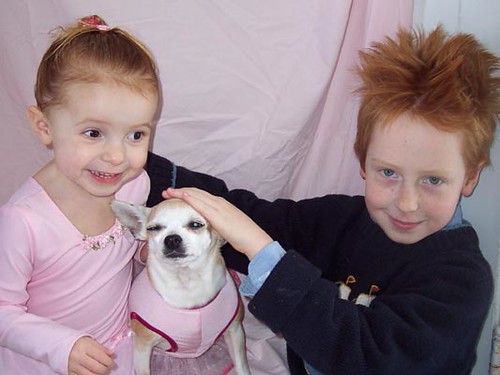
Labels: homeschooling, lessons, script frenzy, writing
How to Make Custom T-Shirts at Home
0 CommentsBy Lostcheerio on Wednesday, May 02, 2007 at 11:50 AM.
I made six t-shirts for our small homeschool co-op with this method, and it worked great. I let Benny pick the color of the paint and Sadie pick the color of the shirt, but apart from that they weren't able to help too much because of the razors involved. Hey, you can't always make it a teaching moment. Especially when there are razors.
Supplies list:
T-shirts
Acrylic, permanent, unwashable paint
Paintbrush
Freezer Paper
Masking Tape
X-Acto knife
Iron and ironing board
Piece of cardboard as big as design
1. Make your design.
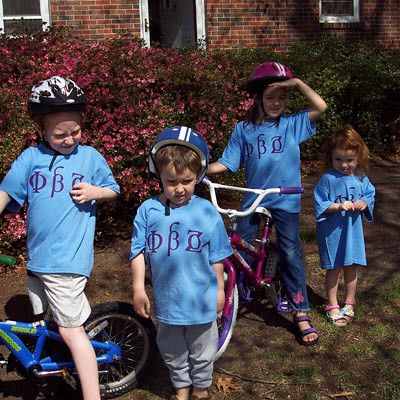
We named our co-op "Phi Bensa Zoe Academy" using our kids names to invent new and serious-sounding Greek letters. Then we invented the "new" Greek letters to go with, and that was the shirt. Whatever design you choose, print it out in black and white on a piece of paper. How complicated can it be? Depends how fussy you want to get with the cutting out and the ironing later.
2. Tape six pieces of freezer paper to a cutting board, and your design on top.
If you're making six shirts, use six pieces of freezer paper. Make sure the wax side is down!
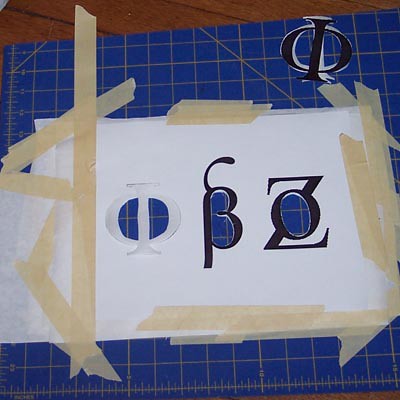
3. Cut out your design.
Using the X-Acto knife, remove all pieces of your design. With a sharp knife or razor, you can easily go through seven layers of paper.
4. Make sure you save any inner pieces, because you'll need them later to complete thhe stencils.
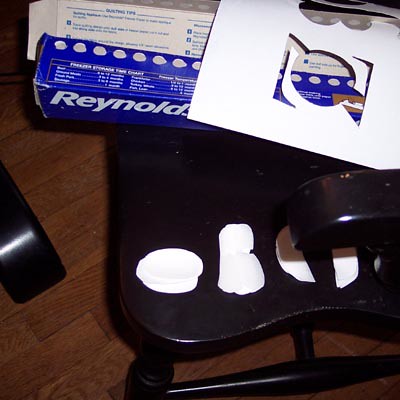
5. When the stencils are all cut out, remove them carefully from the cutting board and peel off all the tape that was sticking them down.
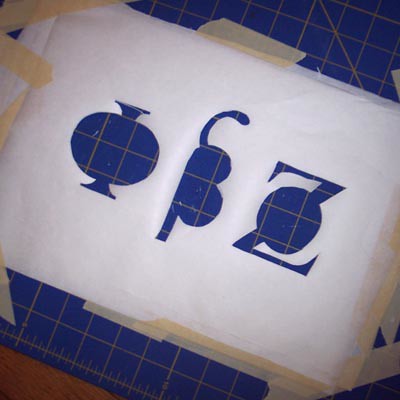
6. Lay one shirt on the ironing board and slide the piece of cardboard up inside it, under where you want the design to go. Iron the stencil on, wax side down, and make sure all little edges and bits are firmly ironed into place.
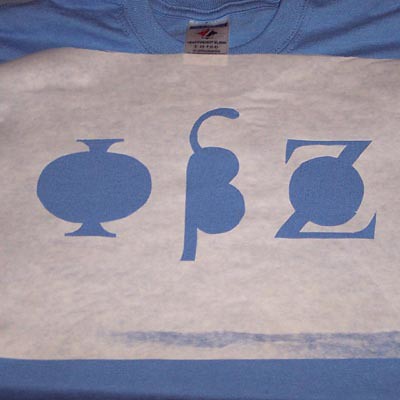
7. Now replace all the little inner bits and iron those down too.
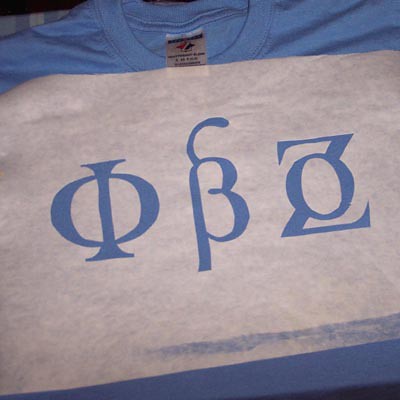
8. Paint over the stencil, and make sure every bit of exposed fabric gets fully covered. This is pretty much the only part the kids can help with in anything but an advisory position. You don't have to glop on a whole lot of paint, but use a stiff brush and work the paint down into the fibers.
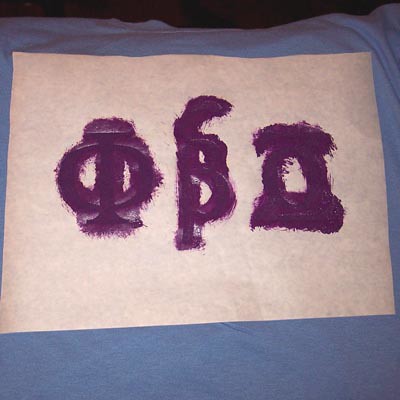
9. Peel up the stencil. Here, mine is peeled except for the inner bits.
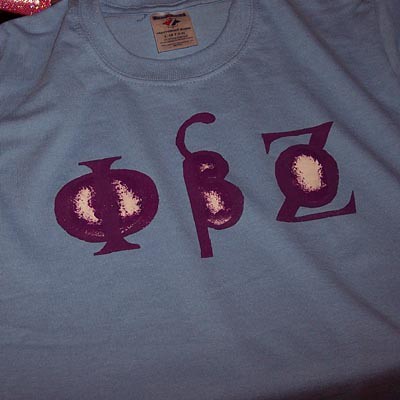
10. Before washing this shirt, you should iron it to set the paint. Iron on the back, and put paper under the front so it doesn't get on your ironing board if it bleeds at all. Then you can wash it as usual!
Final product:
Labels: crafts, custom, homeschooling, projects, t-shirts
I know that this is no big deal. And I'm not worried about how he will do on the test. I've looked at the standards of learning for first grade and he has more than finished them. It won't take a lot of time out of our week to do this test, and then it'll be over. But I don't want him to take it.
I like homeschooling because we can study whatever the children are interested in, and move at a pace that is comfortable and challenging for him. I like the fact that he's not in public school, where standardized tests are so important, and the teachers have to spend a large part of the year making sure the material on them is drilled into the children's heads. I don't think "No Child Left Behind" is doing anyone any favors -- I know lots of parents and teachers that violently loathe the whole system, and the teach-to-the-test phenomenon is one of the big reasons we homeschool.
Yet here we are, looking down the barrel of a standardized test.
In order to continue homeschooling, without being put on a year's probation, we have to score above the 25th percentile. That's a pretty low number, so it's not like I'm nervous and intimidated. I'm just irritated, and to be honest, part of why I'm irritated is that the standard is so low. If he had to score above the 90th percentile, I might feel like, okay, this has a purpose. But sitting him down in front of this test for several hours so that he can try to score over the 25th percentile seems ridiculous. Sorry if I sound petulant, or snotty, but it's like loading up a show jumper in a horse trailer, packing up all of its tack and equipment, driving across the country, settling in at the show grounds, grooming and prepping him on show day, and then walking him out into the ring to step over a two by four on the ground.
Consider the year we've had. We've studied the Galapagos Islands, Handel's operas, the moons of Jupiter, rain forest insects. We've finished addition and subtraction, moved on to multiplication and division. We've learned to say things like "There are more humans than horses" in Spanish. We've been skiing, swimming, horseback-riding and hiking. He earned a green belt in karate, finished Suzuki book 2, and learned the breast stroke. He participated in an egg drop contest, an art show, a book club, many recitals, and an acting class. He has learned to read chapter books and reads voraciously to himself, at a middle school level. This year we went to aquariums in three different states. But this not enough of a first grade experience. In fact, none of this matters at all. What really matters to the school district is that now he has to get into the 26th percentile on the California Achievement Test.
So what is my problem? I have to ask myself -- am I looking for approval here? Am I looking for someone in the public school system to say, "Wow, you were right, Lydia! You CAN do a good job homeschooling! We never would have been able to do all that stuff with him. Good job!" I mean, obviously, that is a stupid thing to wish for. They're not there to lead cheers for me; they're just there to make sure we're not sitting in our basement peeling potatoes all day. I get that. There is no prize for homeschooling well except the homeschooling itself, and the fine education of your child. And that should be prize enough.
AND IT IS.
Except now that the test time has come around, I suddenly find myself having all these thoughts. Feeling so resentful. Demanding that someone recognize that my child has worked hard and enthusiastically, that I have knocked myself out teaching, and that we don't need to be measured by this stick. Is it just the introduction of any kind of evalutation that makes me want to somehow "win"? Am I such an overachiever that I can't be in the same room with a test without wanting to ace it? Am I putting to much of myself into this "number" that we will get back from the testing service?
I have to tell you: I have bought two test-prep workbooks for Benny and he's been doing them. I don't understand why I'm doing this -- it truly makes no difference if he scores a 35 or a 95. It is all the same, and no one ever needs to know these scores except me, my husband, and the person who's making a checkmark next to Benny's name on a list of kids who are "approved."
But I'll know. When I was a kid, I was a good test-taker. I was a National Merit Scholar. I was a good little brick in the red schoolhouse -- born to sit in class and write down points and regurgitate in bubble sheets. Benny is not that child. he is an independent thinker, a creative powerhouse, a rocketship. Am I incapable of just letting him take the test however he pleases, and not oppressing him with all this practice? It's so ingrained in me that anything less than perfect on anything that looks like a test is an outright failure. Why do I have to inflict that on my child?
I blame the test. And I don't know what to do about it.
Labels: homeschooling, testing
At Christmas time, we drove for two days to get to Marshfield, Wisconsin. My husband's family lives there. It is a long, long trip, let me tell you. The length of this trip that we make to Wisconsin was the reason I changed my mind about the whole TV-in-the-vehicle idea. When Benny was a toddler, I went from haughtily saying "Is there no place that children are safe from the degrading influence of television??" to peevishly saying "Isn't there some way we can hang the screen closer to his face?" It's a long drive.
On our way to Wisconsin, we go through Chicago. Depending on what time of day it is, we often take a side trip down Lake Shore Drive, and wind our way up Sheridan, through the old neighborhood. Sometimes we even drive past our old apartment and reminisce about when we had to identify our vehicle by the antenna because the rest was buried under six feet of snow. When we get done with Chicago, and the northern suburbs are floating past us, we know we are almost there. At that point in the trip, this time, we saw this:

A double rainbow, right across the freeway, starting over there and ending right over here:

Completely amazing. Maybe the pictures don't do it justice, or maybe they do, I can't really tell because I remember it so clearly. It was without a doubt the best rainbow I have ever seen. Both of the children were delighted. I was delighted. It was delightful.
It led to a brief discussion of what makes rainbows, and how light is refracted, and what colors are in sunlight. The conversation was brief because A) my child is seven and B) I don't really know PRECISELY what makes rainbows take that shape, but it will for sure lead to a book from the library, and a deeper investigation. Now that they've seen a really spectacular, clear, strong rainbow with their own eyes, the book will make sense.
That may be the best rainbow I ever see in my life. It occurred to me, as I was driving, that the only way Dan and I would have seen this rainbow, and the only way the kids would have seen it, is if we made this trip. This is a trip that I obviously dread, not because of the visit, but because of the trip itself. But, the only way to see that particular rainbow was to get out the door and take the trip.
THIS IS WHERE I USE THE RAINBOW AS A METAPHOR! PREPARE YOURSELF! :D
The rainbow was a catalyst for a teaching moment, about light and refraction and whatnot. Moreover, seeing the rainbow was also like running into other teaching moments, randomly throughout our lives. We encounter them without planning to, without organizing it. One of the major things I've learned about homeschooling in the last couple of years is that I can really trust the learning to happen, at random times, when there is a perfect illustration in front of them, if I get out into the world with the kids.
Here's an example: During Sadie's swimming lesson at the YMCA, Benny and I were sitting in the hot tub, watching. We had been swimming in the pool, and then we sat in the hot tub for about 20 minutes, and then we got back in the pool. When we got back into the pool, it was REALLY cold, and Benny noticed this. We discussed the reasons why the water felt colder, the idiom "Everything is relative" and we looked at the temperature of the pool and hot tub (on the wall) and using what we knew about the temperature of the human body, we speculated what temperature would feel too cold or too hot, etc.
This could have been learned from a book. But it was better to teach it right there, at that very moment, when we were freezing after sitting in the hot tub. Like it was easier to talk about the refraction of white light when we were standing, open-mouthed, gaping at a beautiful rainbow. And what I am learning, as I keep doing this, is that I have to first make sure that we're out in the world, where rainbows occur, and that I'm paying attention, so I can annoy my children with educational information just as soon as the rainbow fades.
Labels: family, homeschooling, travels
Not all unschoolers are freewheeling rock stars with no thought for tomorrow. Some of us wild woollly renegades who eschew formal curriculums still make plans and goals for our homeschooling year. Last year my objectives were pretty vague and insubstantial, but this year, since Benny is old enough to kind of understand and participate in his own goal-making, I decided to formalize it somewhat.
1. Benny gets his blue belt. Benny does Tang Soo Do, which is Korean karate, at the Norfolk Karate Academy. He got his green belt shortly before Christmas, so I'm hoping the blue belt will come before the end of next year. He has to learn the next form, which is pretty hard, and he also has to take his behavior in class to the next level. No nose-picking, for sure, for the blue belt. Possibly even no spinning and humming.
2. Benny finishes the Rosetta Stone Spanish curriculum, level 1. We've been toying around with this for a couple of years, and it's time to get serious. We're probably going to be going to Guatemala later in the year, so all of us have this one on our lists.
3. Finish Suzuki book 3. This will be good and bad, since for book 4 we have to find a new teacher, but since he's already on the third song of a seven song book, I'm anticipating this one will be done by the end of 2007.
4. Read 12 books. In December we read Charlotte's Web, which was our first real chapter book (besides books like Mrs. Piggle Wiggle where the chapters are episodic). So I'm thinking we read another chapter book each month, titles to be determined, as we see what works. Considering Alice in Wonderland first, since they're kinda familiar with that, and maybe Charlie and the Chocolate Factory after that.
5. Memorize 12 poems. Last year we memorized "The Owl and the Pussycat" by Edward Lear and "Have You Seen The Wind?" by Christina Rossetti. I want to do another poem each month, learning vocab and also general stuff about each one we do. This month we're doing "The Walrus and the Carpenter" by Lewis Carroll. Benny picked it. I was going to push for "Stopping by Woods on a Snowy Evening" but whatever!
6. Do 50 science experiments. The kids love to do these and they don't have to be fancy or complicated. We have neat books to choose experiments from, and I'm just going to let them pick what they want to do each time.
7. Teach Sadie her letters and numbers. She kinda knows some of them. I don't know if we'll do a really straightforward "Letter of the Week" approach, but we have to knock that out before she considers going to preschool.
8. Learn multiplication table. We actually started this this morning and got through the 7s. I mean, he doesn't have them memorized, but he gets the concept. I just let him draw numbers into grids that I made, and let him figure it out on his own. It was actually very magical to watch this, and it all happened before 9 am! Tomorrow we'll do 8, 9, 10, 11, and 12, and isn't that as far as the official multiplication table goes?
9. Do H-Z in South America. We did interesting lessons and songs that we made up ourselves for A-G, on South America topics, then we abandoned the project when Sadie became, let's just say, an obstacle to progress in various ways. Mostly that she was 2. Now she's going to be 3 and we're going to finish this project.
10. Get Sadie into ballet, and graduate from Prezuki to regular Suzuki lessons on the violin. And potty trained, but hey, that'll happen soon, RIGHT?
There you have it. Our fun year. Let the learning begin.
Labels: holidays, homeschooling
I'm not an expert, but here's how I understand it: If you sign up for K12, you can take your child out of school, and teach your child at home. You receive a curriculum and a computer, you are connected to a teacher to help you. All of this is free to you. Instead of footing the bill for an expensive curriculum, you get all the materials you'll need to keep him or her right up to speed with the school kids. Sounds like a deal.
There are, of course, negatives. You have to keep a rigid attendance record, you have to follow the program exactly, and your child's work gets graded by the teacher at the public school. The school receives money from the government, based on your child's attendance, so your school is still the one responsible for your child's education, not you.
It's controversial. The public school people are saying, hey, if you like to homeschool, that's fine! We'll help you do that, and it's FREE! The homeschooling community responds that K12 isn't homeschooling in any other way than the location of the child's desk. It is a government sponsored public school education, which happens to take place in your home. The parents have no say in what is studied, how fast the lessons progress, or what grades are received. One of the main reasons a lot of us homeschool is to take charge of our own kids' education, and K12 definitely keeps the reins in the hands of the public school system.
Now, it's also possible to pay for the K12 curriculum and do it on your own, outside the school's guidance. And in some states it's not even possible to do it for free, because that kind of virtual charter school isn't available everywhere yet. The reason for all the local controversy is that it's just become available in one county in Western Virginia. And peopole have begun singing its praises on local homeschooling e-lists.
The problem is that K12 kind of presents itself as homeschooling when it's really not. For people who only want to homeschool because they don't want their children physically in the school building, it might be fine. But K12 will not help anyone who is looking to improve on a public school education. You can, of course, supplement and enrich what they're getting from K12, just like you can if youd kid is in any school, but you will be keeping an hourly log of studies, and the school will still be dictating what you study, and when, and for how long.
Nothing is really free, right? K12 isn't free either.
One can understand why local homeschoolers are quick to demand that K12 advocates use the appropriate terminology when describing it. Our right to homeschool our children is precious, and if a public-school-at-home program is seen as equivalent to a parent-led or child-led education outside the school system altogether, that's a problem. You can imagine lawmakers pondering the question: If those nuts are so intent on homeschooling, why can't they all just use K12? Tthen the public schools can still be funded for all their children that have been removed from the system! Lovely for the public schools. Not so lovely for those of us who want more for our kids than a forced march through the Standards of Learning.
One person on one of the lists actually told us she was going to keep all emails promoting K12 as homeschooling and send them to an attorney. Right about now, if you logged on to any of our lists and said you were homeschooling with K12, you'd probably get pelted with used Latin textbooks. They are right to be protective of their terms.
However, as K12 comes into our state, and more people inevitably start using it, and start attending park days and commenting on our e-lists, attending our classes, we have to be aware of the way we talk about these "terms" around the children. A child doing K12 at home for free is feeling a lot of the same things about homeschooling as a child whose parents spent $1000 on a different curriculum, or the child who is unschooled, or the child doing a correspondence course. The kids don't know the difference.
While we can dispute nomenclature among outselves on discussion lists populated by opinionated adults, it's important we don't make these kids (or parents) feel any less welcome or part of things because they're doing K12. Maybe what I'm saying is obvious, and my concern is unfounded, but it worries me that an unnecessary rift may be created here, in a community that needs to stick together. Our legal needs may be different, but our social needs, and surely the social needs of our kids, are the same. I think the answer is to do the best we can to educate people about what K12 really is, and then to say, if they choose to do it anyway, and if it's really what they want, "Welcome to the party. Come take a seat by me."
Labels: homeschooling, K12
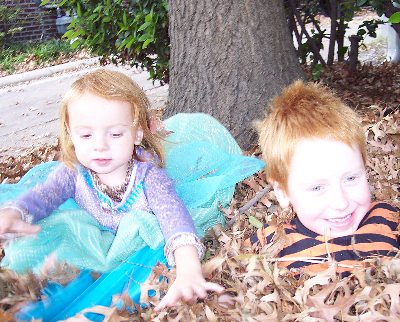
What's so cool about homeschooling? I'll tell you. When you're a homeschooler you can slam through your math in your pajamas, and then yank on some sweatpants and bundle yourself outside to jump in the leaves like a maniac with your little sister. Did I mention that your little sister is still wearing her Halloween costume, days later?
I guess it also means you can wear "surprised troll doll" as a hairstyle without comment from anyone but your mother, whose comment is, "Awww, you're cute."
Here's another thing that's cool about homeschooling in the fall: You can go to Homeschool Park Day and play outside as hard as you can all afternoon and not get hot!
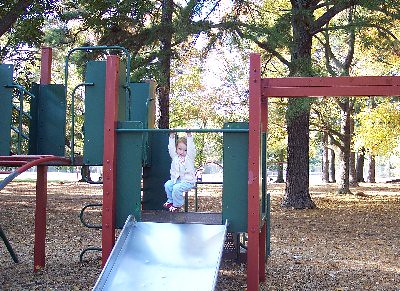
Look, Sadie can hang now. She also did her first ride on a "big girl" swing, and had her first trip down the too-high slide, which was followed by many more trips down the too-high slide. Yes, the kids are still fascinated with roller coasters:
Homeschool Park Day was *fantastic* on Thursday. All the moms, apparently, knit. So we all sat there yakking and knitting and occasionally peeling our toddlers off the too-high slide or pushing them on swings. The kids built fairy houses and bird houses out of sticks and pine needles and whatnot, and had a fantastic time. It sounds lame to sit on a park bench knitting, but we make it work. Really.
Labels: family, friends, homeschooling
My heart breaks like everyone else's, and I get furious too when I hear about violence in schools. It's not like my homeschooliang friends and I are sitting around giving each other smug high fives because our kids aren't sitting in a school box like fish in a barrel, waiting for anyone with a grudge against life to walk in and slaughter them.
Those are my neighbor's kids, my family's kids -- even if they're in Pennsylvania or in Chechnya or in Colorado. It's my problem, too. It bothers me that some people, even some homeschoolers themselves, see homeschooling as a way to opt out of engagement with the atrocities of life, to become separate and safe. I've heard more than one person say, in the last few weeks, that she's considering homeschoolng because of the danger of life in school.
The truth is that violence happens everywhere, and my children are out and about more than the rest -- don't we have a higher likelihood of being hit by a car, or accosted in a parking lot, or stalked by a weirdo, or something like that. School violence is particularly nauseating and horrifying, but just like highway accidents don't keep me at home, school violence doesn't keep me from putting my kids in school.
Pulling children out of school because of nuts with guns, hoping to protect them from the wildness of this human life, is a kind of sad and desperate act. Obviously I more than others think you should do what you like with your own children, and that homeschooling is fantastically fun and beneficial for children. But I don't think fear is a good reason. The homeschooling community isn't safe from maniacs with firepower. Homeschooling is just a different way to educate your children.
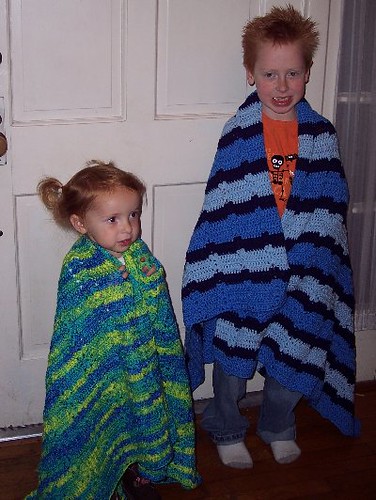
Do blankets from Grandma keep them safe? Or just happy and warm? :D
Labels: homeschooling
Disney World: What Did We Learn?
0 CommentsBy Lostcheerio on Thursday, October 26, 2006 at 12:59 PM.
If you think about what you're doing, and plan ahead, and research, and prepare, and organize, you can learn a lot from Disney World. On the other hand, if you do none of those things, you can probably learn a lot too.
We did not think or prepare. We tried at every turn to avoid analyzing anything, applying ourselves, deconstructing the images with which we were presented, or allowing ourselves to expand and grow. We did not learn "Hello" in all the languages at Epcot's World Lagoon and practice speaking with the native employees. I did not prepare a scavenger hunt and teach children in advance what they would see, and therefore we did not identify the landmarks from the different countries. We bypassed all the interesting tropical ducks at Animal Kingdom and rushed straight to the biggest roller coaster, which we rode as many times as possible. We danced around like fools in the sun, rather than comparing Disney's Snow White with Grimm's version. When the ferry came close enough for us to see Cinderella's castle for the first time, we did not mention Neuschwannstein.
So, what did the kids learn from our trip, given our staunch refusal to teach them anything?

The biggest thing they both learned was that it's okay to really fully commit to earnest thrill. Because Disney World is devoid of sarcasm and smirkiness, it feels right for kids and adults to behave like giddy lunatics, to sing out loud, to gambol and cavort, and to shout "WHEE!!!" My children are naturally very unselfconscious. This place was their natural element.
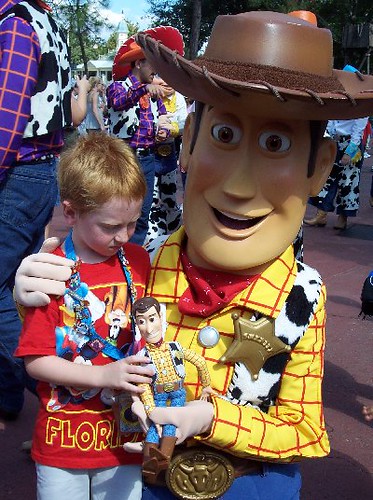
They learned to volunteer. Benny volunteered to be in several different shows -- Turtle Talk with Crush, the Festival of the Lion King, Belle's Storytime, Woody's Cowboy Camp, and others. His experience with Disney World was, as a result, very interactive. He learned that jumping up and saying, "I WILL!" makes everything fun. In connection with this, he also learned some social lessons like waiting your turn, accepting the role you're handed, sitting down when your part is over, and being thankful for the fact that you're included. He did all this very gracefully. Sadie did not have the same experience -- she tended to shrink into Mom or Dad's chest cavity whenever anyone with a big giant head approached. :D
Here's a little video of Benny as Gaston in Belle's story show:
They learned to be brave on rollercoasters. This was one that Benny had already mastered (lunatic that he is) but that Sadie was able to experience this year, on her first roller coaster ever, which she rode four times in immediate succession, and never wanted to leave. The bravery of these children astonished us over and over during this trip -- they are truly going to be wonderfully bold adults if this kind of behavior continues! With the obvious exception of meeting people with giant fake heads, which Sadie needs more time to master.
Here's a picture of me and Benny riding Expedition Everest at Animal Kingdom:

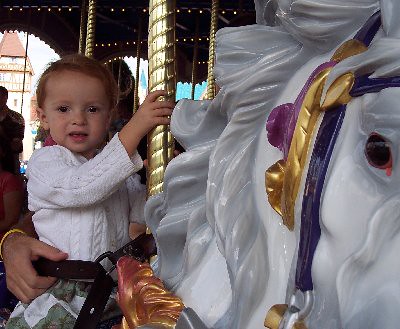
They learned time management, as we discussed and decided what to do so that everyone got to do what they liked (Sadie liked Haunted Mansion and Pirates of the Caribbean, and Benny liked anything that went fast around corners and down terrible drops) and we minimized our line time and had food when we needed it. This was also a good lesson in sharing resources (time mainly) and enjoying other people's happiness. Yes, we rode the carousel about 16 more times than Benny probably would have chosen to ride it, and Sadie spent a lot of time waiting for Benny to ride roller coasters. But they didn't complain.
Benny learned a lot through pin trading. If you don't know, here's how it works -- Disney makes little metal and enamel pins showing a million different things. Some commemorate events, some represent characters or rides, some are special pins for holidays, etc. Kids (and adults) collect these and wear them on lanyards around their necks, then trade with other people wearing pins. If a park employee (sorry, "cast member") has pins on, they will always trade with you whatever pin you want for whatever one you want to give them. Benny loved interacting with people like this, and by the end of the trip had become an enthustiastic trader. He had never been exposed to the idea of "collecting" before, so the whole concept of one pin being more valuable or rare than another was new, the whole concept of trading was new, and this gave him the opportunity to talk to a lot of people, which he of course loves.
They learned patience in lines, although in the middle of October, especially in the mornings, the lines were nonexistent! They learned to try new foods. They bonded together as siblings in new ways. Benny met a host of new friends from all over the world. He came up with a new opening line for meeting people (his favorite pastime). On the monorail after the Halloween party he sidled up to a girl dressed as Ariel and said, "You're BEAUTIFUL." That, as it turned out, was a good opening line! He had a conversation with her and her mom all the way back to the parking lot.
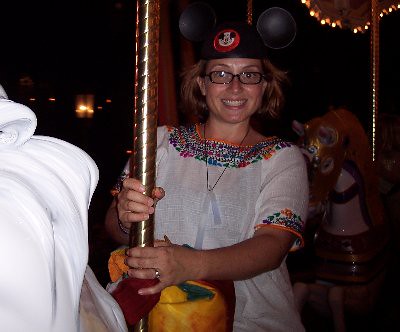
We're back from Disney World, and we had a fantastic time, even me:
For more of my Disney videos, you can visit my YouTube channel here.
For more of our pictures, you can visit my Flickr gallery here.
Labels: disney world, homeschooling, lessons, travels
Homeschool Teachers are Learning Too
0 CommentsBy Lostcheerio on Thursday, September 28, 2006 at 6:48 PM.
Good question.
Most homeschooling moms are not experts in art or math or French or the history of Australia or how pandas digest bamboo. A lot of us have degrees in one thing or another, I happen to have a couple of degrees in literature. Helps when we get to 19th century American fiction, but a fat lot of good that does me when we're learning about art!
So what do we do, when we're out of our element, and our kids need us to know what we're doing? Several choices:
1. We study hard and stay one step ahead of our kids. This happens mostly when a family is following a set curriculum. Mom may be teaching Junior calculus and she may be learning calculus the night before, real quick, before Junior gets to that lesson.
2. We learn right along with them. This happens more in a child-led learning environment, where we're following the kid's interests. What kinds of things do you want to learn about, Junior? Okay, let's get some books from the library, look it up on the internet, and delve in. A child who sees his mother actively seeking informationn, getting excited about learning right beside him, being open to new things, is getting a fine example of how learning should happen. Mom's not learning because she has to, she's not learning because someone is making her, she's learning because she wants to. That's a valuable lesson. When I was a kid, my parents read constantly, and I learned by example that reading was great entertainment. By watching them, I learned what to do. So when I'm struggling through my Spanish lessons with Rosetta Stone, or looking up Galapagos iguanas on the internet, my child is seeing how learning can be fun and exciting, when no one is making you do it.
3. Another choice is to hire someone to teach your child who *is* an expert. Benny has a swimming teacher, a violin teacher, and a karate teacher -- these are things that we have decided he really needs an expert to teach him. So we go find an expert. If he gets very interested in painting, we're fortunate to have an art teacher in the family, as his Ahno has an art degree and has taught it at various levels in and out of traditiobnal school. So, on that, we're covered. We have friends who take art lessons at the Children's Museum in Portsmouth. Or at the SOFA art camps. There are lots of ways to outsource this one! :D
So let's return to the topic of art and the way we're dealing with it this week. What happened at the museum on Wednesday?
We both wandered around the galleries. I let him lead. He knows pretty much where everything is. Our challenge, our mission, as we discussed it on the way there, was to look at the brush strokes and see how the artists used the shapes of their brush strokes to form the pictures.
Benny pointed out, about half way through the impressionist gallery, that when the brush strokes are bigger and more obvious, the paintings are less realistic. When the brush strokes are smaller, the paintings look more real. I used my fresh info about the Mona Lisa to inform him that the thickness of the paint matters too, so we compared that painting of the table laid out with silverware (very realistic) to the one of the Harlem River in winter, which is more abstract and where the artist used really thick paint.
After we had this revelation, we went on to the modern and contemporary galleries, where Benny visited his favorite painting, shown below. He rushed past it quickly, looking at it out of the corner of his eye, back and forth, back and forth, and told me that it looked good to him when the pattern mixed together because it was going by fast.

He also studied the installation with all the TVs shaped into a king, and we talked about how art doesn't have to be paint on a canvas or a bronze sculpture, etc. We left when the kids were ready to leave, and went out to look at the fountain, which is always Sadie's favorite part.

Benny went home and started painting another canvas. He showed me how he was using brush strokes to make shadows on the water. I'm not entirely sure how that works, but I'm glad he's experimenting with it and I'm glad he learned from his trip to the museum.
I'm so glad this question was asked, because think a lot of people are wary of homeschooling for this reason. They think, "I'm not an expert, I can't possibly teach my child everything he needs to know." The truth is, you can. First grade art isn't really a good example, because of course anybody can handle the curriculum here -- identifying primary colors, zig-zag and spotted lines, geometric and organic shapes, size relationships, creating a piece of art inspired by a poem, etc. You can see all the standards of learning for visual arts for Virginia here. If you can't stay on top of that list, maybe you really shouldn't be homeschooling your kid! ;D Just kidding. But seriously. I think Benny's okay, at least for now. If we get into serious stuff, and I'm over my head, I have access to experts to help me out.
You raise a good question. And part of what makes homeschooling so interesting, for many of us who do it, is that homeschooling is learning too.
Labels: art, homeschooling
Homeschoolers field a lot of questions about what we do. People ask all kinds of things, like what we do for math, or if it's hard to homeschool with a baby around, or whatever. "Why did you decide to homeschool?" is the most common one, and I've whittled my answer to that one down to this: "We just don't have time for school."
There's one certain type of question about homeschooling that's really an implied criticism. "What about socialization?" or "Don't kids need structure?" are really ways of saying, "I think kids need socialization and structure in traditional school." I suggest two ways to deal with these questions -- either ask the person for clarification, endlessly, or to admit that the person is right and you're wrong.
Answer a question with a question. What do you mean by socialization, exactly? What kinds of kids should he be socializing with? What age of person is right for his socialization? What do you mean by structure? Do you think bells and lines are an important part of structure? What kind of structure would be too much structure, in your opinion? The key here is that you have to be SUPER innocent and direct and really truly ask these questions as if you want to know. Which, maybe, you even do -- always interesting to know how these things are perceived by people. Being snarky will exacerbate the problem, but being really genuinely interested in what that nosy neighbor has to say will deflate it. And you don't have to defend yourself or even give your opinion. If she brought it up, let her elaborate on it.
The other comeback is to say, "You know, you're right. He does need structure." Or, "You're totally right, socialization is really important." On some level, you do agree with the person -- even if the "structure" you're referring to is the frame of the car that keeps him from falling out of it onto the street, and the socialization is with his own mother and father. The point is, then the conversation is over, the nosy neighbor feels like she won, and you can move on with whatever you were going to do anyway. Who cares if she truly deeply understands and agrees with everything you're doing? She probably never would, even if you turned yourself inside out and let her examine your sweet, earnest homeschooling heart.
I think that arguing with people only pumps up the notion that homeschoolers are all frothing idealogues who want to bring down the system. The truth is we're not proselytizing, we're not out to expand our numbers, and we're not even sure *ourselves* what the exact right answers are. My main message about homeschooling, to people that ask me questions, is that it's fun and easy. I will let them decide if it's rotting my children for themselves.
Labels: homeschooling
My real Notice of Intent (or NOI) starts like this:
I am providing notice of my intention to provide home instruction for the child listed below as provided for by 22.1-254.1 of the Code of Virginia (1950) as amended, in lieu of having him attend school.
Then I have to attach my diploma and say what my curriculum is going to be, and I have to give the name and age of Benny and other useful information.
What I'd really like to say is something like this:
Dear Superintendent,
I really have no problem with your schools and I'm sure the first grade teachers in your district are fantastic. I'm happy to keep paying you with our taxes, and I appreciate you educating all those kids to the best of your ability. However, I won't be sending Benny to you this year. We just don't have the time.
We want to play the violin, go swimming, ride bikes, do karate, play in the backyard, pretend to be fish, go to the beach, the zoo, the museums, and the circus, visit Ecuador, Disney World, our grandparents, and France. When it's nice outside, we want to go outside. When it's raining or cold, we want to dive into projects that take three days, we want to spend a whole afternoon making playdoh fossils and we can't be bothered to wake up at 7, because I'm afraid we stayed up until 11 reading. We don't want Benny answering to bells, closing books before he's finished or staring at them long after he's lost interest, waiting to eat and use the bathroom, waiting for Tuesdays to do art, waiting for Thursdays to do music, we want to do music all day every day and art whenever we feel like it, and we want to wake up and decide each morning exactly what we want to do that day, and play with our friends a lot, and not have to pack everything cool into the hours between school and dinner. We don't want Benny to do any homework. And I have to be honest with you -- sometimes we just want to play Playstation for 4 hours or watch TV or just lie around. We also want him to help teach his sister the alphabet, and take long baths at strange times, and stay in the pool as long as he wants and sing at the top of his lungs while he's doing his math, and we want him to pick books at the library that are way too hard for him, or way too easy, and spend a long time drawing things we can't figure out, and play with the dog, and go out on the boat, and jump on trampolines, and...

Well, you can see that with all this stuff that we want to do, there's no way we can give you our child from 8:25 in the morning until 2:45 in the afternoon, so while I appreciate everything that our Norfolk Public School has to offer, I will be keeping my child with his family this year, and we'll let you know next year how it all turned out.
Love,
LYDIA
Speaking of flexible schedules, we're going to South Carolina for a month. We *will* be back for the first day of school, but I think we'll sleep in that day, then maybe go to the playground.
Labels: homeschooling

 Subscribe in a reader


